Trusted Since 1994 in Sinchon, Seoul · 1:1 Personalized Eye Surgery, Facial Lifting & Anti-Aging by One Board-Certified Specialist
5.0 Verified Patient Satisfaction
en-US


Rhinoplasty
Rhinoplasty by Nose Type
Rhinoplasty — nose reshaping surgery — is not a single procedure. The nose is a structurally complex three-dimensional feature composed of bone, cartilage, soft tissue, and skin — and the specific concerns that bring each patient to surgery vary considerably.
Schedule a ConsultationWhat Is Rhinoplasty by Nose Type?
Rhinoplasty — nose reshaping surgery — is not a single procedure. The nose is a structurally complex three-dimensional feature composed of bone, cartilage, soft tissue, and skin — and the specific concerns that bring each patient to surgery vary considerably. A low nasal bridge requires augmentation; a bulbous tip requires cartilage refinement; a nasal hump requires reduction and osteotomy; a deviated nose requires bone and cartilage correction simultaneously. Each nose type presents a distinct surgical challenge — and the approach must be tailored to the specific structural characteristics of each patient's nose rather than applied from a standard template.
Rhinoplasty by nose type means that the surgical plan — the techniques used, the materials placed, the structures addressed — is designed from the ground up based on what the individual's nose actually needs. At Yonsei Natural Beauty Aesthetic Surgical Clinic, every rhinoplasty is assessed, planned, and performed personally by Dr. Eun-jung Lee, with no delegation at any stage of care. The goal is a nose that looks proportionate, natural, and consistent with the patient's overall facial features — not an idealized standard shape imposed regardless of the starting point.
Common Nose Types and Surgical Approaches
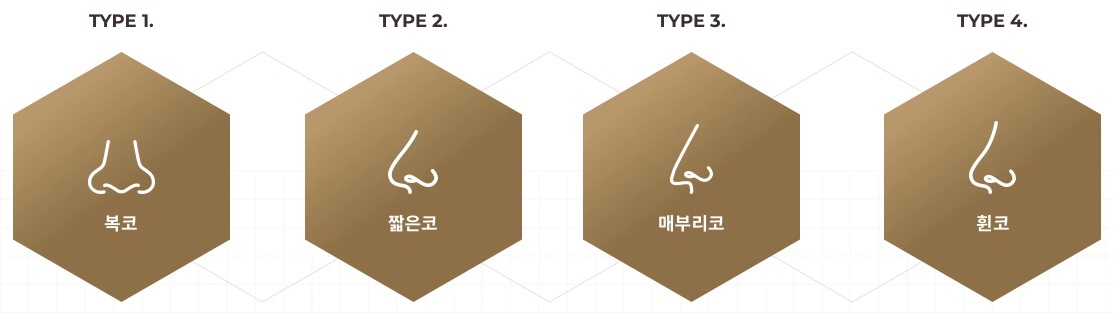
- Low Bridge / Flat Nose: A nasal bridge that sits low relative to the face creates a flat profile and reduces the definition of the midface. Augmentation rhinoplasty uses an implant — typically silicone — or cartilage graft to raise the bridge height and restore facial dimension. The approach and material are selected based on the degree of augmentation needed and the individual skin thickness.
- Bulbous or Undefined Tip: A rounded, undefined nasal tip — caused by excess lower lateral cartilage volume, weak cartilage structure, or thick overlying skin — lacks the definition and projection that give the nose a refined appearance. Tip rhinoplasty uses cartilage suturing, trimming, or grafting techniques to reshape and define the tip without altering the bridge.
- Deviated Nose: A nose that deviates to one side — from the bridge, the tip, or both — typically involves both bony and cartilaginous components. Correction requires osteotomy to reposition the nasal bones and cartilage work to address the septum and tip — a multi-component procedure that demands precise surgical planning and execution.
- Hump Nose: A dorsal hump — a convex prominence on the nasal bridge — disrupts the smooth profile line from forehead to tip. Hump reduction involves careful removal of the excess bone and cartilage, typically followed by osteotomy to narrow the resulting open roof and restore natural bridge width.
- Wide or Broad Nose: A nose that appears wide from the front — due to wide nasal bones, a broad tip, or wide alar bases — can be narrowed through osteotomy, tip refinement, and alar base reduction, individually or in combination based on where the width originates.
- Short or Upturned Nose: A nose where the tip rotates excessively upward — revealing the nostrils when viewed from the front — requires tip de-rotation and elongation through cartilage grafting. This is one of the more technically challenging nose types to correct, as the skin envelope must accommodate the structural extension without excessive tension.
- Long or Drooping Nose: A nose that appears long or whose tip droops downward — particularly when smiling — can be shortened and rotated upward through tip work and cartilage modification, improving the balance between the nose and the lip.
- Wide Alar Base: Where the width of the alar base — the outer edges of the nostrils — is disproportionate to the nose and face, alar base reduction through small precisely placed excisions narrows the base and improves overall nasal proportion.
Who Is a Candidate for Rhinoplasty?
- Adults in their 20s–50s with a specific nose type concern — whether structural, proportional, or aesthetic — that affects how the nose relates to the rest of the face
- Patients who want a nose that looks like their own, improved — not a standardized result applied regardless of their starting anatomy
- Individuals with multiple concurrent concerns — low bridge combined with a bulbous tip, or a deviated nose with a hump — requiring a combined multi-component approach
- Those who have had prior rhinoplasty with unsatisfactory results and are seeking revision correction
- Patients who want natural-looking results — improvements that are clearly visible to them but do not look obviously surgical to others
- International patients seeking a single-surgeon model where one physician designs and performs the full rhinoplasty and monitors recovery personally
Meet the Specialist: Dr. Eun-jung Lee

Dr. Eun-jung Lee
Plastic Surgery Specialist
Director | Clinical Professor, Yonsei University College of Medicine | Plastic Surgery Specialist, PhD in Medicine
Dr. Eun-jung Lee brings over 25 years of plastic surgery experience to rhinoplasty — approaching each nose as a unique structural challenge requiring individualized assessment and a surgical plan built around what that specific nose actually needs. She completed both her Master's and PhD in Medicine at Yonsei University, holds a Master's in Law from Korea University, and serves as Clinical Professor at Yonsei University College of Medicine.
As former Academic Committee Chair of the Eye Surgery Research Group under the Korean Society of Plastic Surgeons and former Chairperson of the Seoul Medical Tourism Association, Dr. Lee brings both institutional depth and hands-on surgical experience to nasal surgery — a field where the three-dimensional complexity of nasal anatomy demands both technical versatility and careful aesthetic judgment. Every rhinoplasty — from consultation to final follow-up — is managed directly by Dr. Lee.
She holds full membership in the Korean Society of Plastic and Reconstructive Surgeons, Lifetime Membership in the Korean Society for Aesthetic Plastic Surgery, and full membership in the International Society of Plastic Surgeons.
Treatment Areas and Expected Improvements
- Nasal bridge: Augmented, reduced, or straightened based on the specific bridge concern — raising a low bridge, smoothing a hump, or correcting a deviation to restore a balanced, straight bridge profile.
- Nasal tip: Refined through cartilage suturing, trimming, or grafting to improve definition, projection, rotation, and symmetry — producing a tip that is appropriately defined for the patient's facial features without appearing pinched or over-operated.
- Nasal bones: Repositioned through osteotomy where hump reduction, width correction, or deviation requires bony realignment — restoring the structural foundation of the upper nose.
- Alar base: Reduced through precise excision where alar width is disproportionate to the nose and face — narrowing the visible nostril width from the front and improving overall nasal balance.
- Overall facial proportion: A well-planned rhinoplasty improves not just the nose in isolation but the balance of the entire face — the relationship between the nose, eyes, lips, and chin that determines whether a face reads as harmonious and proportionate.
Results vary by nose type, skin thickness, cartilage characteristics, and healing response. No specific outcome is guaranteed, and realistic expectations are established during direct consultation with Dr. Lee.
The Rhinoplasty Process

1. Consultation and Nose Type Assessment: Dr. Lee evaluates the nose comprehensively — assessing bridge height, tip shape and projection, nasal bone width and symmetry, septal position, alar base width, and the relationship between the nose and surrounding facial features. She identifies the specific structural concerns and proposes a surgical approach tailored to the individual's nose type and facial proportions.
2. Surgical Planning: Each rhinoplasty plan is fully customized 1:1. The approach — open (with a small columellar incision) or closed (entirely within the nostrils) — is selected based on the degree and complexity of correction required. Material selection — implant, septal cartilage, ear cartilage, or rib cartilage — is determined by the augmentation or structural needs of the specific case. Pre-operative preparation follows standard surgical protocol.
3. The Procedure: Rhinoplasty is performed on a same-day basis under general anesthesia or local anesthesia with sedation. Operative time varies by the complexity of the nose type and the number of components addressed. The planned structural corrections — augmentation, tip work, osteotomy, alar reduction, or combinations — are performed in sequence through the chosen approach.
4. Immediate Aftercare: A nasal splint is applied following surgery to support the repositioned nasal structures during initial healing. Post-operative swelling and bruising around the nose and periorbital area are expected — more pronounced in cases involving osteotomy. Specific aftercare instructions are provided covering activity restrictions, sleeping position, and nasal care during the initial recovery period.
5. Recovery: The splint is typically removed at approximately one week post-surgery. Swelling — particularly at the tip — resolves gradually over months, with the full refined nasal shape becoming clearer progressively. Osteotomy cases involve more significant initial bruising that resolves over 2 to 3 weeks. Patients should avoid contact sports, glasses pressure on the bridge, and activities that risk nasal trauma during the healing period.
6. Follow-Up: All post-operative monitoring is conducted personally by Dr. Lee. Rhinoplasty follow-up is extended over a longer period than most procedures — swelling at the tip can take up to 12 months to fully resolve, and the final result is assessed at this timeframe. Dr. Lee monitors healing progress throughout.
Results, Safety, and Longevity
Rhinoplasty produces structural changes to the nose that are intended to be permanent — augmentation with well-integrated implant or cartilage, osteotomy that heals in the corrected position, and tip refinements that stabilize as cartilage heals. The result matures progressively over 12 months as swelling fully resolves.
Risks include temporary swelling, bruising, and nasal congestion during healing. Cases involving osteotomy carry a period of more significant bruising around the eyes. Implant-based augmentation carries long-term considerations — including the small risk of implant-related issues over many years — that Dr. Lee discusses during consultation when implant versus cartilage approaches are being compared. Serious complications are rare. All risks, material-specific considerations, and realistic outcome expectations are discussed transparently by Dr. Lee before any surgery is scheduled.
Why Choose Yonsei Natural Beauty Aesthetic Surgical Clinic for Rhinoplasty?

Yonsei Natural Beauty Aesthetic Surgical Clinic has operated on a one-doctor model since 1994 — Dr. Eun-jung Lee personally assesses your nose type, designs the surgical approach, performs every component of the rhinoplasty, and monitors your healing through the full post-operative period. For a procedure where the surgical plan must be built entirely around the individual's specific nasal anatomy, having one surgeon accountable for every decision from assessment to outcome is clinically meaningful.
With over 25 years of plastic surgery experience, an academic appointment as Clinical Professor at Yonsei University College of Medicine, and former leadership of the Eye Surgery Research Group under the Korean Society of Plastic Surgeons, Dr. Lee brings the technical versatility — across augmentation, tip work, osteotomy, alar reduction, and combined approaches — and the aesthetic judgment that individualized rhinoplasty requires.
- 30+ years of continuous single-surgeon practice in Seodaemun-gu, Seoul
- Nose-type-specific surgical planning — approach, technique, and materials selected for each patient's structural needs, not a one-size-fits-all protocol
- Lifetime member, Korean Society for Aesthetic Plastic Surgery; full member, International Society of Plastic Surgeons
- Expanding multilingual support for international patients traveling from the United States and beyond
Patient Experiences
Low Bridge and Bulbous Tip Rhinoplasty, 20s
This patient had a flat nasal bridge and an undefined, rounded tip — two concerns that affected her profile and frontal appearance. After consultation with Dr. Lee, a combined augmentation and tip rhinoplasty was planned and performed in a single session. At her 12-month follow-up, she described the nose as looking naturally more defined and elevated — proportionate to her facial features without any appearance of having had surgery.
Hump Nose Reduction, 30s
A patient in her early 30s had a visible dorsal hump that disrupted her profile line and had been a source of self-consciousness for years. Dr. Lee performed hump reduction with osteotomy to restore a smooth bridge and appropriate nasal width. Following the full healing period, the patient described the profile as significantly more balanced — the hump gone and the nose reading as naturally proportionate to her face.
Ready for a Nose Designed Around Your Specific Anatomy?
If a specific nose type concern — whether a low bridge, undefined tip, hump, deviation, or any combination — is affecting the proportion and harmony of your face, rhinoplasty at Yonsei Natural Beauty Aesthetic Surgical Clinic offers a surgical approach built specifically around your nose's structural characteristics and your facial proportions.
Dr. Eun-jung Lee will assess your nose type directly, design the most appropriate surgical plan, and give you a clear, honest picture of what rhinoplasty can realistically achieve for your appearance.
[Book Your Rhinoplasty Consultation with Dr. Lee]
Contact the clinic directly to schedule your appointment or request information about international patient coordination — multilingual support available for patients traveling to Seoul from abroad.
Other Services
Explore additional procedures tailored to natural facial balance.

Neck Wrinkle Correction
Surgical neck wrinkle correction addresses these structural changes directly.
Learn More

Preauricular Facelift Surgery
Preauricular facelift surgery addresses facial aging at the structural level. The incision is placed within the preauricular zone — in front of and around the ear — where it heals in a naturally concealed location.
Learn More

Under-Eye Fat Repositioning
Under-eye fat repositioning is a surgical procedure that addresses this structural cause directly.
Learn More