Trusted Since 1994 in Sinchon, Seoul · 1:1 Personalized Eye Surgery, Facial Lifting & Anti-Aging by One Board-Certified Specialist
5.0 Verified Patient Satisfaction
en-US


Petite Cosmetic Procedures
Scar Revision Surgery
Scar revision surgery encompasses a range of techniques — from simple scar excision and precise re-closure, to geometric rearrangement techniques such as Z-plasty and W-plasty that redirect tension and reorient the scar along more favorable lines.
Schedule a ConsultationWhat Is Scar Revision Surgery?
Every scar is the result of the body's natural healing response — but not every scar heals in a way that is cosmetically acceptable. Scars that are wide, raised, depressed, discolored, poorly oriented, or located in conspicuous areas of the face or body can cause significant self-consciousness and affect how a person feels about their appearance. While no scar can be completely erased, surgical scar revision can meaningfully improve a scar's visibility, texture, contour, and orientation — making it less noticeable and more consistent with the surrounding skin.
Scar revision surgery encompasses a range of techniques — from simple scar excision and precise re-closure, to geometric rearrangement techniques such as Z-plasty and W-plasty that redirect tension and reorient the scar along more favorable lines. The appropriate technique depends on the scar type, location, age, orientation, and the individual skin characteristics of each patient. At Yonsei Natural Beauty Aesthetic Surgical Clinic, every scar revision procedure is assessed, planned, and performed personally by Dr. Eun-jung Lee, with no delegation at any stage of care.
Who Is a Candidate for Scar Revision Surgery?
- Adults of any age with visible scars from prior surgery, trauma, or injury that are cosmetically bothersome and have fully matured — typically at least 12 months after the original wound closure
- Patients with wide or stretched scars — where the original closure healed under tension, producing a broad, flat scar wider than the natural skin crease
- Individuals with hypertrophic scars — raised, thickened scars that remain within the original wound boundary and may be red or firm
- Those with keloid scars — scars that have grown beyond the original wound boundary, often with an irregular, raised appearance and a tendency to recur
- Patients with depressed or atrophic scars — scars that sit below the surrounding skin surface, creating a pitted or sunken appearance
- Individuals with poorly oriented scars — scars that cross natural skin tension lines or facial contours at an angle that makes them more visible
- Those with contracture scars — scars that have tightened during healing, restricting movement or distorting surrounding tissue
- International patients seeking a single-surgeon model where one physician assesses the scar, designs the revision plan, performs the procedure, and monitors healing personally
Meet the Specialist: Dr. Eun-jung Lee
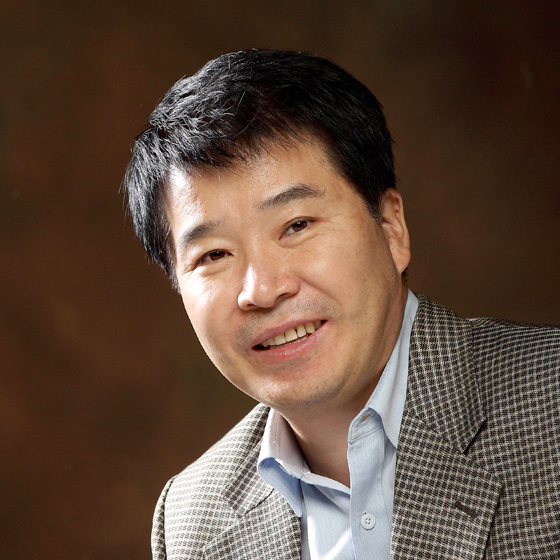
Dr. Eun-jung Lee
Plastic Surgery Specialist
Director | Clinical Professor, Yonsei University College of Medicine | Plastic Surgery Specialist, PhD in Medicine
Dr. Eun-jung Lee brings over 25 years of plastic surgery experience to scar revision — a field where surgical judgment, anatomical knowledge, and an understanding of wound healing biology are as important as technical execution. She completed both her Master's and PhD in Medicine at Yonsei University, holds a Master's in Law from Korea University, and serves as Clinical Professor at Yonsei University College of Medicine.
As former Academic Committee Chair of the Eye Surgery Research Group under the Korean Society of Plastic Surgeons and former Chairperson of the Seoul Medical Tourism Association, Dr. Lee brings both institutional depth and hands-on surgical experience to scar management — including scars in the periorbital area and face, zones where the stakes for cosmetic appearance are highest and where precise technique matters most. Every patient is assessed and treated directly by Dr. Lee, with no hand-offs at any stage.
She holds full membership in the Korean Society of Plastic and Reconstructive Surgeons, Lifetime Membership in the Korean Society for Aesthetic Plastic Surgery, and full membership in the International Society of Plastic Surgeons.
Scar Types and Revision Approaches
Understanding the specific type and characteristics of a scar is the essential first step in planning effective revision. Dr. Lee assesses each scar individually before recommending any approach.
- Wide or Stretched Scars: Scars that healed under excessive tension often spread and widen over time. Revision involves excising the existing scar and re-closing the wound with precise, tension-minimizing technique — producing a finer, less visible scar line. Where the original orientation placed the scar across natural skin tension lines, geometric rearrangement techniques redirect the closure to a more favorable angle.
- Hypertrophic Scars: Raised, thickened scars within the wound boundary are addressed through excision and careful re-closure, combined where indicated with adjunct treatments such as steroid injection or silicone-based scar management to reduce the likelihood of recurrence.
- Keloid Scars: Keloids — scars that extend beyond the original wound — require a particularly carefully planned approach, as simple excision carries a risk of recurrence. Treatment typically combines surgical excision with adjunct measures to minimize the biological drive toward excessive scar formation. Dr. Lee discusses the realistic expectations and recurrence considerations specific to keloid revision during consultation.
- Z-Plasty and W-Plasty: These geometric scar rearrangement techniques reorient a scar by introducing small angled flaps of tissue. Z-plasty is particularly useful for scars that cross natural facial contour lines or cause tissue distortion through tension; W-plasty breaks up a long straight scar into a series of small irregular segments that are less visible to the eye. The appropriate technique is determined by scar location, orientation, and length.
- Depressed or Atrophic Scars: Scars that sit below the surrounding skin surface require a different approach — often involving subcision (releasing the fibrous tethering beneath the scar), re-excision, or combined management with volumetric support where the depression is significant.
The Scar Revision Process
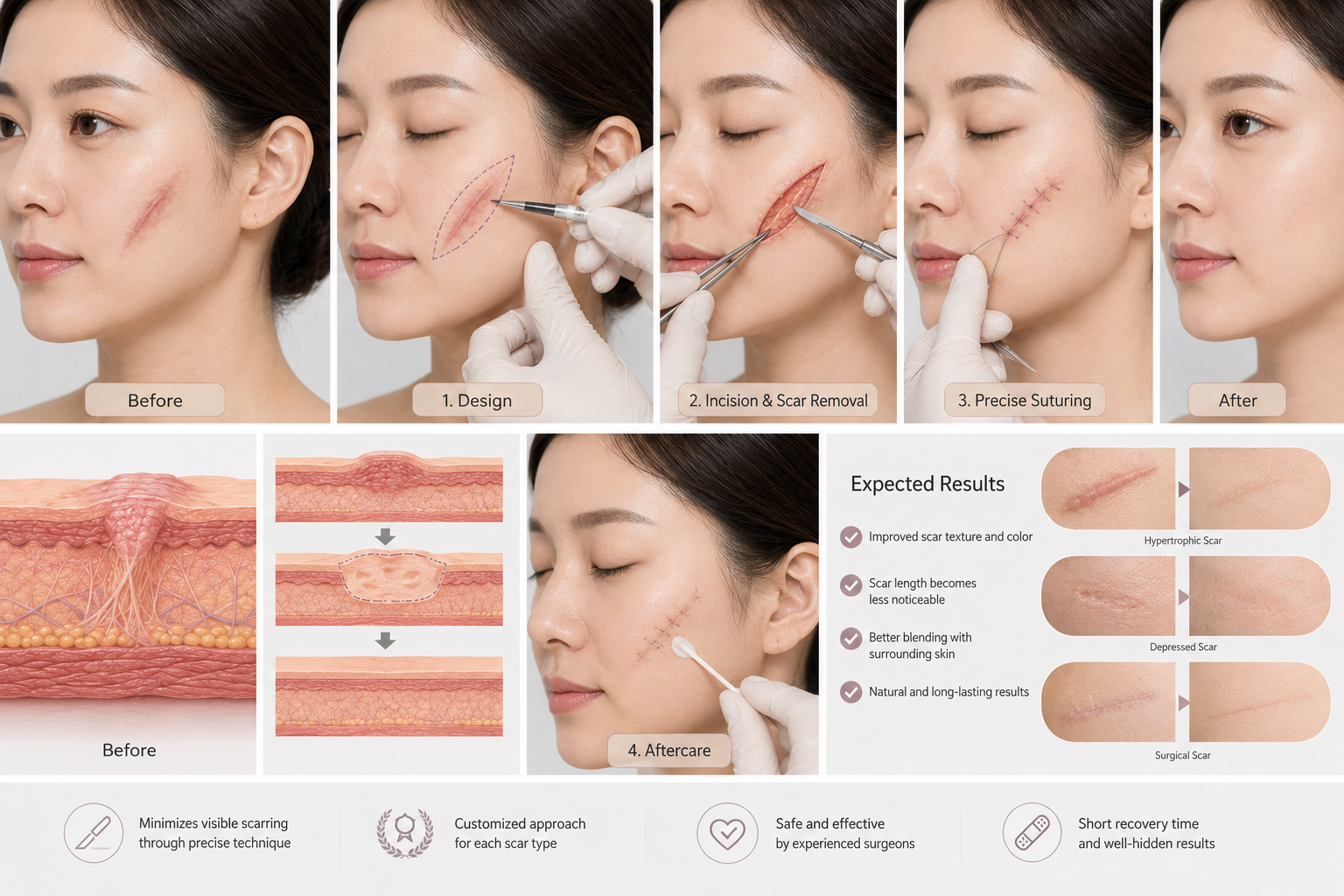
1. Consultation and Scar Assessment: Dr. Lee evaluates the scar hands-on — assessing its type, age, dimensions, orientation, depth, color, texture, and relationship to surrounding skin and structures. She determines the most appropriate revision technique and provides a realistic, honest assessment of what improvement is achievable before any decision is made.
2. Surgical Planning: Each revision plan is fully customized 1:1 to the scar's specific characteristics and location. The technique — simple excision and re-closure, Z-plasty, W-plasty, or combined approaches — is selected based on assessment findings. Pre-operative preparation follows standard surgical protocol.
3. The Procedure: Scar revision is performed on a same-day basis under local anesthesia — no overnight hospitalization required for most facial and body scar revisions. The existing scar is excised and the wound is closed with precise technique designed to minimize the new scar's width and maximize its orientation along natural skin lines. Geometric rearrangement is performed where indicated.
4. Immediate Aftercare: Post-operative wound care instructions are provided to support optimal healing from the new closure. Minimizing tension on the healing wound, protecting it from sun exposure, and following scar management guidance during the maturation period are all important contributors to the final result.
5. Recovery: Recovery varies by the location and extent of the revision. Most patients return to normal daily activities quickly after facial scar revision. The new closure heals progressively — initial redness and visibility reduce over the months following surgery as the revised scar matures.
6. Follow-Up: All post-operative monitoring is conducted personally by Dr. Lee. Scar revision follow-up is particularly important — the final result of a scar revision is not visible immediately but develops over a 12-month maturation period. Dr. Lee monitors healing progress and can recommend adjunct scar management measures during this period where appropriate.
Results, Safety, and Longevity
Scar revision does not eliminate a scar — it replaces an existing scar with a new one that is planned, precisely executed, and optimally oriented to be as inconspicuous as possible. The goal is meaningful improvement in the scar's visibility, texture, and contour — not complete removal.
The degree of improvement achievable depends on scar type, location, skin characteristics, and individual healing biology. Scars in areas of low tension and along natural skin lines tend to heal most favorably after revision. Keloid-prone patients face a higher risk of recurrence regardless of technique — a consideration that is discussed transparently during consultation. The revised scar matures over approximately 12 months, during which color, texture, and width continue to improve.
Risks include the standard considerations of any surgical procedure — temporary swelling, bruising, and a small risk of infection — as well as the possibility that the revised scar does not improve as much as hoped, or in keloid cases, that the scar recurs. All risks and realistic outcome parameters specific to each patient's scar are discussed by Dr. Lee before any procedure is scheduled.
Why Choose Yonsei Natural Beauty Aesthetic Surgical Clinic for Scar Revision?

Yonsei Natural Beauty Aesthetic Surgical Clinic has operated on a one-doctor model since 1994 — Dr. Eun-jung Lee personally assesses your scar, plans the revision technique, performs the procedure, and monitors your healing at every follow-up visit. For scar revision, where the outcome depends entirely on the accuracy of the initial assessment and the precision of the surgical technique, this direct accountability from a board-certified plastic surgery specialist matters.
Dr. Lee's 25+ years of plastic surgery experience — including extensive work in the periorbital and facial zones where scar visibility is most consequential — combined with her academic appointment as Clinical Professor at Yonsei University College of Medicine, gives her both the technical depth and the realistic, transparent communication that scar revision patients need and deserve.
- 30+ years of continuous single-surgeon practice in Seodaemun-gu, Seoul
- Full range of revision techniques — simple excision, Z-plasty, W-plasty, and combined approaches selected based on individual scar characteristics
- Lifetime member, Korean Society for Aesthetic Plastic Surgery; full member, International Society of Plastic Surgeons
- Expanding multilingual support for international patients traveling from the United States and beyond
Patient Experiences
Facial Scar Revision Patient, 30s
This patient had a visible facial scar from a prior laceration repair that had healed wide and crossed a natural facial contour line — making it more noticeable than a scar of its size would typically be. After consultation with Dr. Lee, a Z-plasty revision was performed to reorient the scar along a more favorable line. At the 12-month follow-up, the patient described the revised scar as significantly less visible — blending more naturally with the surrounding skin and no longer drawing the eye.
Post-Surgical Scar Revision Patient, 40s
A patient in her early 40s had a widened scar from a prior eyelid procedure that had healed under more tension than ideal. Dr. Lee assessed the scar and performed a precise excision and re-closure with tension-minimizing technique. Following the 12-month maturation period, the patient noted the scar was considerably finer and less pigmented than before — blending more naturally into the eyelid crease.
Ready to Improve the Appearance of an Unwanted Scar?
If a visible scar — from prior surgery, trauma, or injury — is affecting your appearance or confidence, scar revision at Yonsei Natural Beauty Aesthetic Surgical Clinic offers a precisely planned, personally managed surgical improvement designed around your scar's specific characteristics.
Dr. Eun-jung Lee will assess your scar directly, recommend the most appropriate revision technique, and give you a clear, honest picture of what improvement is realistically achievable — and what the healing timeline looks like.
[Book Your Scar Revision Consultation with Dr. Lee]
Contact the clinic directly to schedule your appointment or request information about international patient coordination — multilingual support available for patients traveling to Seoul from abroad.
Other Services
Explore additional procedures tailored to natural facial balance.

Neck Wrinkle Correction
Surgical neck wrinkle correction addresses these structural changes directly.
Learn More

Preauricular Facelift Surgery
Preauricular facelift surgery addresses facial aging at the structural level. The incision is placed within the preauricular zone — in front of and around the ear — where it heals in a naturally concealed location.
Learn More

Under-Eye Fat Repositioning
Under-eye fat repositioning is a surgical procedure that addresses this structural cause directly.
Learn More